
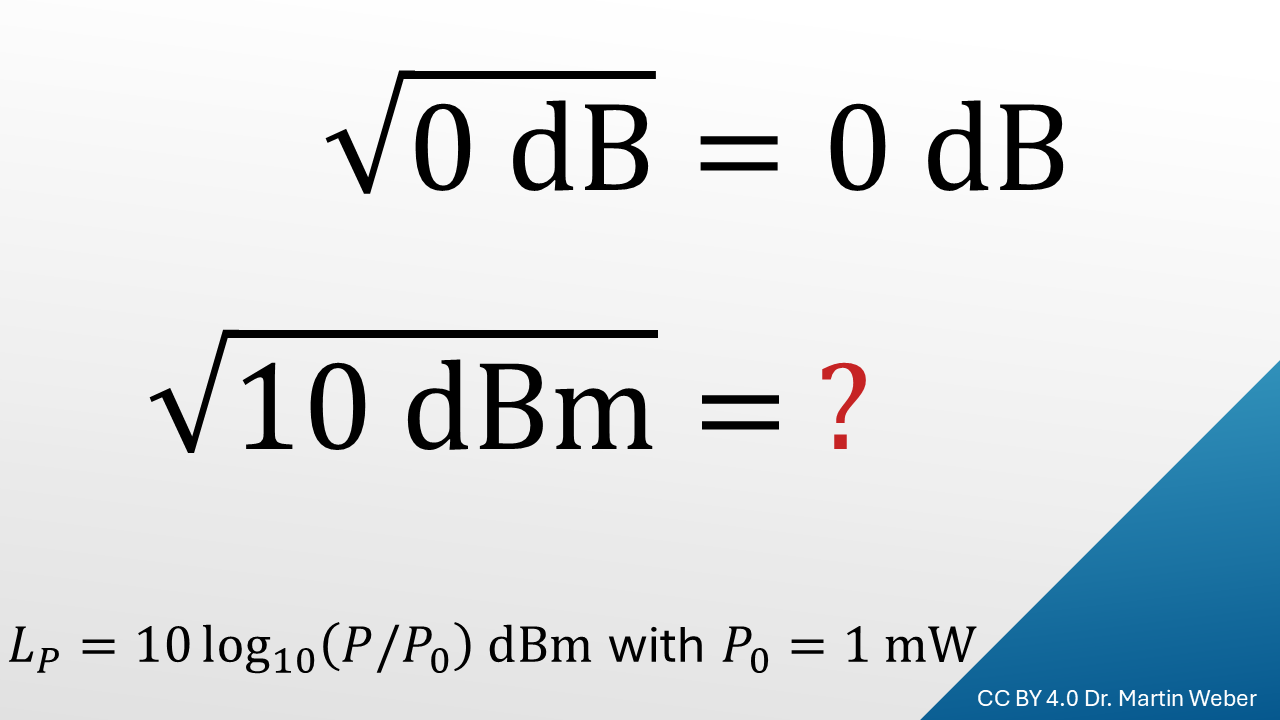
What is
That was a question that I recently saw on YouTube, but the answer is quite obvious if you remember that 100 % is just equal to 1.
Here, I would like to do the same with the decibel. That unit also describes a ratio. 0 dB is again equal to 1, so that ratio will not change, no matter what exponent is used.
But the very interesting question is, what will happen if there is a different value? Or what if a “special” decibel, like dBm, with a reference power of 1 mW is used? Also, what will happen to the reference unit if the root is drawn?
I came to the conclusion that the question does not make sense for any values other than 0 dB. Let’s assume the values 10 mW and 0.1 mW, which results in a ratio of 10/1 and 1/10. This results in 10 dBm and -10 dBm. The root of the first value will result in a real number, whereas the second value will give two complex solutions.
But if 1 µW is used as a reference, the same values would be 20 dBµ and 40 dBµ and then there would be only real-valued solutions.
So the reference value decided about the solvability of the equation and on the number of the solutions. Furthermore, I cannot see any practical application for this equation. But it was an interesting question from the theoretical point of view. Maybe there is more to discover.