
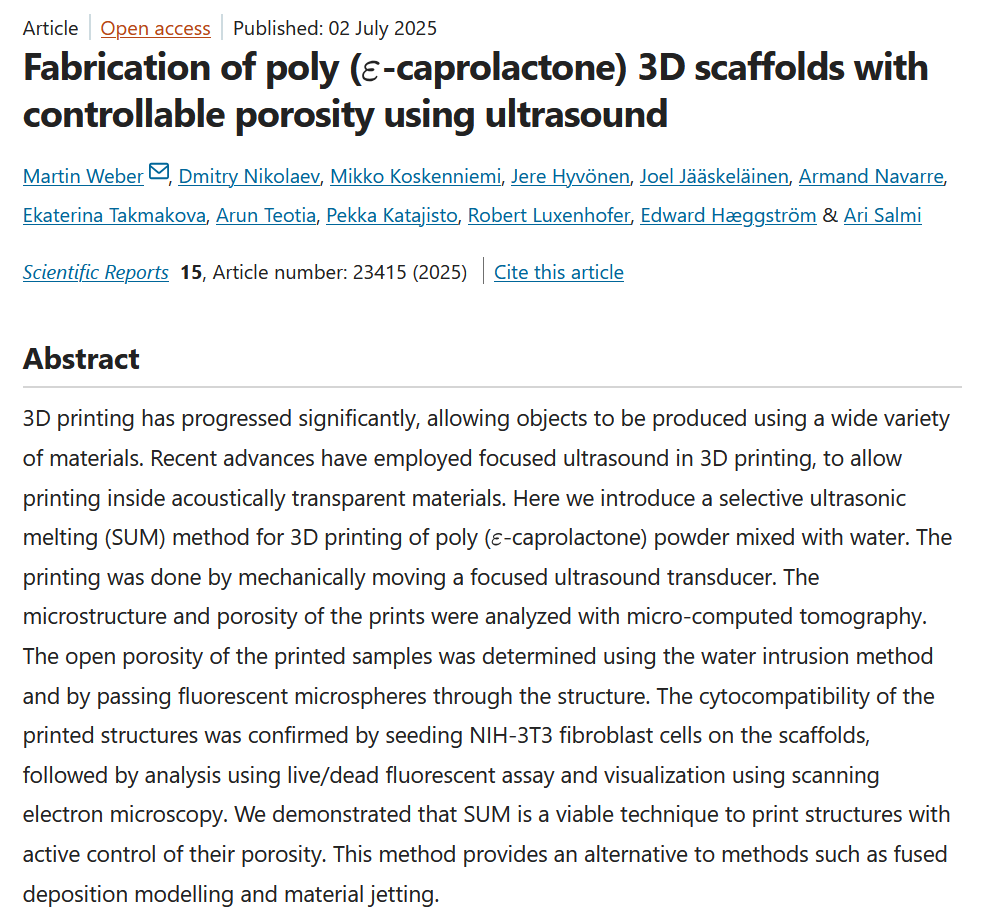
I’m happy to share that the paper 🌐DOI:10.1038/s41598-025-06818-9 has just been published in Scientific Reports. It demonstrates how polycaprolactone (PCL) powder can be melted in a focused ultrasonic field in the presence of water. This also gives control over the porosity of the printed objects. As PCL is already used in biomedical applications, this new fabrication method can enable advanced biomedical applications.
The fascinating aspect of acoustic 3D printing is that it can be performed inside objects with ease (as long as ultrasound can be transmitted through the boundary). Doing the same with optical and laser-based printing methods is challenging.
Where would you like to apply this method?
The article is published under CC BY 4.0 🌐CC BY 4.0