
Spoiler: I was young and had time. 😉
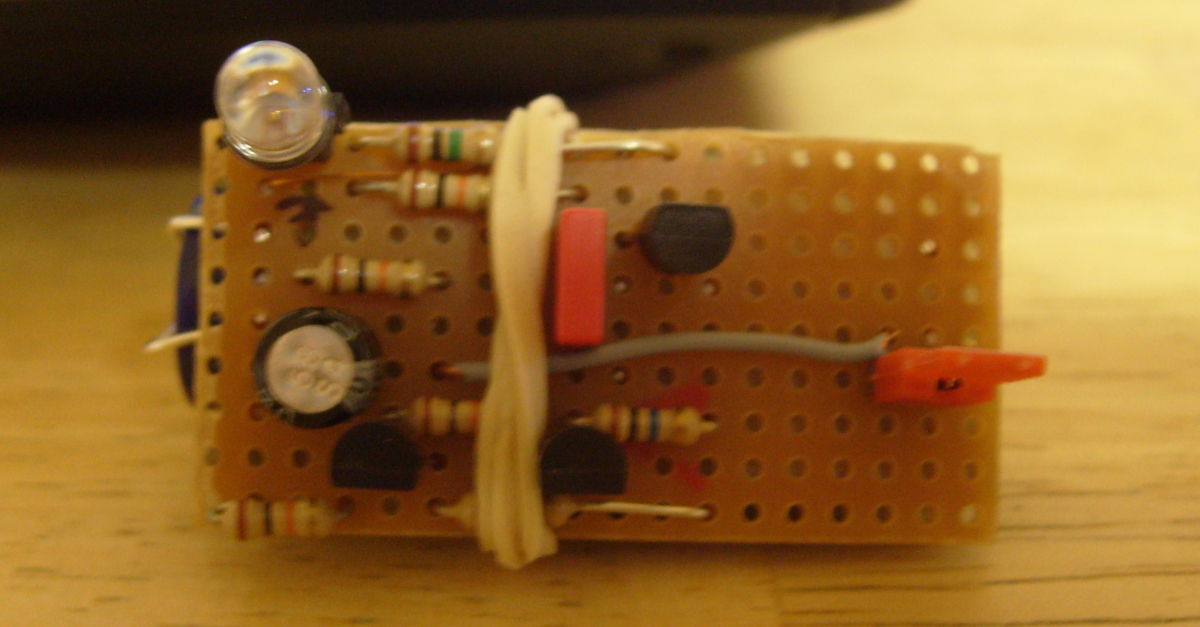
I remember that I got, when I was around 10 years old, an electronic experiment kit (Electronic Experimentiersystem 4000, Busch GmbH & Co., Germany). It consists of a few capacitors, resistors, a red LED, and 2 transistors. At the beginning, I had no idea what electronics was, but it was very cool to replicate the circuits and see them work.
When I was older, I learned in school that there is a way to write computer programs. I got highly interested and decided to buy a book about programming. That is how I took my first steps in QBasic. That was a very rudimentary experience, as the “IDE” was a DOS program just running in a console window. But it taught me the basics about programming. Later I moved on to RealBasic, which was at that time distributed on disks attached to computer magazines. There I could finally create user interfaces by drag and drop.
In the upcoming internet, I also found a simple but great graphical simulation tool for logic circuits. There I learned the basics about logic circuits. I wanted to see these logic circuits in practice, so I bought a book on that topic in 2003. Furthermore, I got a solderless breadboard and a few logic ICs of the 7400 series from a small electronics shop. Now I was able to see logic chips like an NAND-gate or a 7-segment decoder doing math in action. The book was ending with an outlook on microcontroler, which – if I recall correctly – would have been the next volume of the series.
So I read on the internet about different microcontroller families. At that time, the two most popular families for hobbyists were the Microchip PIC microcontrollers and the Atmel AVR platform. I had already seen both in different catalogs of electronic distributors and knew that the chips could be ordered for little money. But for me as a pupil, the most difficult challenge was how to program the microcontroller. The official development boards were way above the savings in my piggy bank. Therefore, I was pleased to find online a schematic for a programmer for the AVR platform, which consists of just a few logic ICs. I was able to solder the circuit myself on a prototype board, and so I was finally capable of flashing chips. I dived deeper into programming the AVR microcontroller in assembly with the help of several online tutorials. From this experience, I got a lot of knowledge about how a computer works on the bit level.
This all happened when I was still in school. For example, I remember that during a trip to Munich in my 10th class, I used some spare time to travel to the Conrad electronics store. It was located in the city center, and there I bought the components for an IR receiver. I had found the circuit a few weeks before in a computer magazine, and it was used to control a PC with a remote control. I just noticed that I kept a copy of the article; it was in PC Magazin 8/2003 (Germany).
Looking back, it is astonishing how much I learned self-motivated outside of school about electronics. But how that finally led me towards the field of ultrasonics is a separate story. I will tell it another time.